
DIGEST: Food shocks as solvency risk – the financial case for food system resilience
We tend to think of food crises in terms of empty shelves and hunger, but the financial sector is starting to see them as a threat to the solvency of the global economy. In the latest Root and Reason (formerly AFN Network+) resilience webinar, Professor Aled Jones of Anglia Ruskin University discussed how even a modest drop in global food production of 5 to 8 per cent can send prices spiralling by 300 to 500 per cent, with cascading effects on corporate bonds, government debt and political stability. His earlier work with Lloyd’s of London established these dynamics a decade ago. The BAFR-UK project he now leads is asking what happens when those financial shocks meet with chronic vulnerabilities.
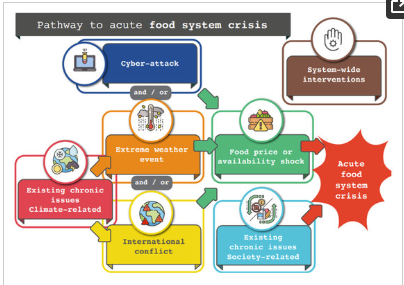
This webinar was hosted by the AFN Network+, which has since become Root and Reason, the food resilience collective. A previous digest examined some of the research behind this work, which identified the “tinderbox” of chronic issues, a set of acute triggers, and interventions that experts ranked highest to address them. In this webinar, Aled went further, exploring the financial underpinnings of food system risk, a serious game that helps demonstrate why bold action stalls, and why 13 of the 15 crises the team identified two years ago have already occurred.
Quick Take
- Food is starting to be understood as the underpinning of everything in finance. A food system shock doesn’t just mean higher grocery bills: it can destabilise corporate and government bonds, trigger capital flight, and cause widespread business interruption. The financial sector is increasingly treating food, climate and biodiversity as a unified solvency risk, rather than as separate concerns.
- The system is dangerously concentrated. Four companies control 75 per cent of global grain distribution, and 10 countries grow 80 per cent of the world’s food. A failure at any one of these nodes could cascade globally, and market and government responses are unpredictable because they depend on the prevailing sentiment.
- The future is arriving faster than expected. Of 15 theoretical crises identified two years ago, 13 have now occurred at some scale, from cyber-attacks on Co-op and Marks & Spencer to trade wars and climate-driven harvest failures. The research is now tracking events in real time.
- People agree on bold action, but the system stops them. A serious game developed through the BAFR-UK project that Aled leads puts stakeholders from across the food system through simulated crises. When participants collaborate freely, they converge quickly on ambitious interventions. Separated into sector silos such as retail, banking, government, and farming, tensions slow them down, but even then, escalating crises push them back toward bold action. The problem isn’t a lack of willingness: it’s that in the real world, very little space exists for these cross-sector conversations.
- Resilience starts local. Rather than waiting for top-down reform, Aled argued that resilience can be built through mutual support between local businesses and community-led conversations about food. The goal is that cities and towns re-engage with food as part of their culture and social fabric.
Deep Dive
Food risk is financial risk
The financial framing was a distinctive contribution from this webinar. Aled drew on a decade of work, beginning with a collaboration with Lloyd’s of London that developed a scenario of a plausible global production shock of an 8 to 10 per cent loss in wheat, maize, soya and rice in a single year, roughly in line with what happened in 2007–08.
In 2007-08 food prices didn’t rise proportionally; they spiked by 300 to 500 per cent. In the scenario this increase in price meant the effects cascaded well beyond the food sector with agricultural stocks surging and then crashing, corporate and government bonds destabilising, and capital fleeing to safer assets. Insurance markets faced exposure across political risk, cargo, trade credit, and business interruption. In short, a food shock is not only a food problem but an economic event that spreads through the entire financial system.
Since that early understanding the financial sector has changed how it frames the risk. Aled described a growing recognition that food, climate and biodiversity are not separate concerns but a single, interconnected threat to what the Institute and Faculty of Actuaries called “planetary solvency.” This language shifts the conversation from environmental policy to systemic financial stability and it’s a framing that could finally get the attention of treasuries and central banks.
A serious game reveals the barriers
The BAFR-UK project has developed the Barefood serious game, which puts participants from across the food system through simulated crises and asks them to respond. The game has been played with groups including retailers, banks, government officials, farmers, NGOs and agri-food tech companies.
The findings cut against the assumption that disagreement is the obstacle to action. When participants worked together across sectors, they converged on bold interventions with surprising ease. Even when the game was restructured to separate them into sector silos, which did increase tension, participants still converged on ambitious responses after a couple of rounds of escalating pressure.
The implication is that people across the food system are readier for bold action than the policy landscape suggests. The bottleneck is isolation: sectors don’t routinely talk to each other, and few fora exist to make that happen. Meanwhile, the crises the game simulates are no longer hypothetical. Of 15 crises the team identified two years ago, from cyber-attacks and trade wars to drought and financial shocks, 13 have occurred at some scale.
Resilience from the ground up
Systemic coordination may be the long game, but what can be done now? Aled argued that resilience also needs to be built from the bottom up. Local businesses can ask not just how they survive a crisis, but how the businesses and communities around them survive, because mutual resilience is stronger than individual preparedness.
He pointed to community-led food discussions as an undervalued tool: towns and cities re-engaging with food as part of their culture and social fabric, so that people have genuine conversations about where their food comes from and what they want the food system to do. This kind of local engagement, Aled suggested, can feed back up into national-level resilience in ways that top-down policy alone cannot achieve.
An exchange at the close of the webinar sharpened this point: asked whether crises could also be windows of opportunity for systemic change, Aled said that many of the solutions such as agroecology, right to food legislation, and major investment in domestic farming face political resistance under normal conditions but become feasible when a crisis makes bold action look necessary rather than radical. The challenge is having a credible plan ready to go when that moment arrives.
What Now?
This webinar makes clear that the financial and systemic dimensions of food risk are more advanced than most policy discussions acknowledge. The chronic vulnerabilities we mapped in our previous digest are now colliding with the acute shocks that were supposed to be theoretical. The Barefood serious game shows that people across the system are ready to act, but are lacking sufficient structures for cross-sector collaboration.
As we have argued throughout this series, and in our Roadmap for Resilience, disruption is coming, and the question is whether we use the time we have to build readiness or wait for crisis to force our hand. That question is at the heart of why the AFN Network+ has become Root and Reason: to build the readiness, accountability and cross-sector collaboration that the evidence tells us we need. Watters, Juan Pablo Cordero, Molly Watson, Judith Batchelar, John Ingram, Jude Irons, Tom MacMillan, Kerry Whiteside