

Digest: Food as a right: what it would take to put justice at the centre of the food system
TL;DR
Professor Molly Anderson opened our new food justice series days after an Amnesty poll found that 82% of people in the UK think there should be a legal right to food. Why is food system change so slow, and what would make it more just?
- Injustice in the food system persists because concentrated power makes it profitable and the rules that would prevent it are missing.
- Human rights, including the right to food, set the standard, and justice addresses who gets what, who has a voice and whose culture and knowledge are respected.
- Brazil’s cash transfers and food councils, and local food social security experiments in France and Belgium, show what treating food as a right involves.
- Bottom line: a food system that is resilient but unjust will not maintain public support, and changing it takes alliances, legal and political pressure and new spaces for food justice together.
We know, more or less, what a healthier and more sustainable food system would look like. So why is change so slow? At our latest webinar, Professor Molly Anderson answered with the image of an hourglass. At the base are the world’s farmers and farm workers, and at the top are the eight billion of us who eat. Between them is a narrow middle made up of a handful of traders, seed and chemical firms, processors and retailers, through which almost everything must pass. Whoever controls that middle decides what gets grown, what it costs, who profits and who goes without. This, she argued, is why people go hungry in places where food is plentiful, often within the same city.
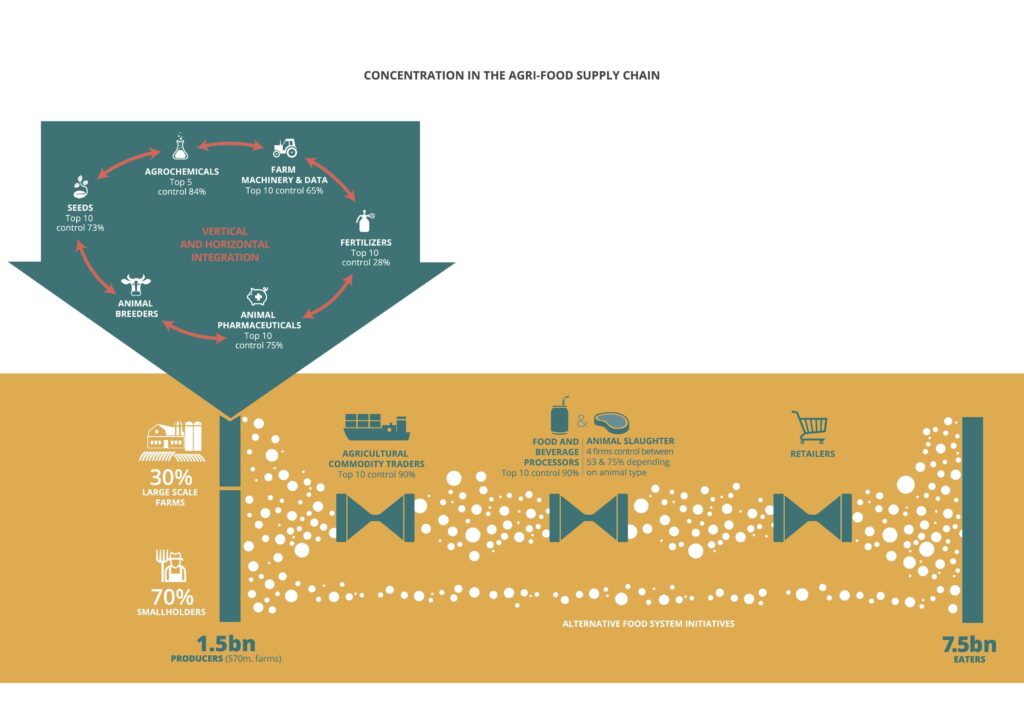
Source: IPES-FOOD (2017) Too Big to Feed
Anderson is a member of the International Panel of Experts on Sustainable Food Systems (IPES-Food) and a leading voice on the right to food in wealthy nations. She spoke three days after Amnesty International UK published polling in which three quarters of people in the UK said they, or someone they know, had worried about the cost of food in the past year, and 82% said there should be a legal right to food.
Over the past year our webinars have asked how to make the UK food system more resilient to climate shocks, geopolitical disruption and rising costs. A system can be resilient and secure and still fail many of the people within it. This session opened a new series on food justice with a basic question: what would it take to put justice at the heart of how we grow, govern and distribute our food?
Quick Take
- A sustainable food system also has to be just. The EAT-Lancet Commission’s 2025 report added justice to its 2019 analysis of healthy and sustainable diets. It found that fewer than 1% of the world’s people live in a “safe and just space,” and that the wealthiest 30% of people drive more than 70% of food-related environmental impacts.
- Injustice persists where it is profitable and unregulated. Anderson’s explanation is that differences in power make exploitation or abuse pay for some actors, while the regulatory guardrails that would prevent it are missing. She said concentration is increasing in every part of the food system: grain trading was among the first to concentrate, and retail is catching up.
- Change needs alliances, resistance and new spaces for food justice together. Alliances across interest groups are best built by showing that change brings widespread material benefits and that diverse people are heard. Court orders, legislation, protest, boycotts and voting all have a part to play, and no single strategy has worked alone.
- Some places already treat food as a right. Brazil’s Bolsa Família pays conditional cash transfers to women in low-income families, tied to school enrolment and children’s health visits. In France and Belgium, local experiments are testing a food branch of the social security system.
- Justice is a condition of resilience. A resilient and secure food system will not win public support or last if it is riddled with injustice, Anderson argued. She also cautioned against defining resilience as bouncing back to an earlier status quo, including food systems that run on oil and so remain “hostage to whoever controls the oil”.
Deep Dive
Rights turn justice into obligations
Anderson defined injustice as occurring wherever human rights are violated. The right to food sits within the right to an adequate standard of living in the Universal Declaration of Human Rights. The voluntary guidelines developed by the Committee on World Food Security, as Anderson put it, ask every country to start where it is and move towards fulfilling that right. Newer instruments extend the framework: the 2018 UN Declaration on the Rights of Peasants covers land, seeds and decent work; and Ecuador was the first country to recognise the rights of nature.
She used the EAT-Lancet Commission’s three forms of justice to explain what this food justice covers: distributional (everyone gets what they need), representational (everyone has a voice in decisions) and recognitional (people’s cultures, values and ways of knowing are respected). Scholars often add three more, she said: procedural justice (people are treated fairly), retributive justice (those who break the law are punished) and restorative justice (the damage caused by injustice is healed). All six are connected, and all are essential. She also said that some philosophers see injustice wherever relationships of care and interdependence are absent, and that the movements now feeding people after floods and fires are where political power is being rebuilt.
Power is challenged on several fronts at once
Power in the food system can be financial, legal or institutional, Anderson said, and it can come from favoured representation in key forums or from institutional inertia. In the United States, she said, courts have successfully challenged decisions to disqualify people from food assistance or to attach unreasonable work requirements to it.
She also set out what the EAT-Lancet Commission says is needed in three areas. Decent work requires living wages, closing the gender pay gap, and enforcing laws against forced and child labour, harassment and unsafe conditions. Meaningful voice and representation requires collective bargaining for food workers and farmers, a legal framework to limit market concentration, and better transparency and access to information. Recognising and protecting marginalised groups requires social protection policies and healthy, sustainable meals in schools and other institutions. IPES-Food’s new report, Food Work, which Anderson contributed to, describes the exploitation of labour across the food system.
Food as a right is already being tried
Anderson’s main example was Brazil. The Bolsa Família programme involves a cash transfer to low-income families, conditional on enrolling children in school and taking them for health checks and vaccinations. The payments go mainly to women, which she said strengthens their control of household resources. She called the programme the primary driver of lower extreme poverty and income inequality in Brazil, and said it had contributed to fewer hospitalisations and deaths. Alongside it, there are food security councils that bring people’s voices from local to national level. Jair Bolsonaro tried to roll back many of these programmes, Anderson said, and President Lula has now restored them, starting with the councils.
Her European example was the movement in France and Belgium for sécurité sociale de l’alimentation, a food branch of the social security system. In local experiments, participants receive a monthly allocation to spend on food that meets standards set by democratic assemblies. Anderson compared it with healthcare: an earlier generation decided that healthcare was too important to be left to the market, and the current one is arguing that the same is true of food. She also pointed to the publicly owned grocery stores now being debated by city and provincial governments in the US and Canada.
What the audience wanted to test
The chair asked what rules would have to change to sustain the care people showed each other during the pandemic. Anderson’s first answer was reliance on charity. Healthy food is a human right, she said, and wherever food is provided it must be provided with dignity. One attendee added two UK observations: furlough was an important part of what allowed people to volunteer during the pandemic, and food injustice here is closely tied to high rents and land, rather than to healthcare as in the US.
An attendee from a community supported agriculture network asked whether money should go to maximising food for people in poverty now, or to slower agroecological community work that seems to last longer. “Both are necessary,” Anderson replied: people need to eat today, and it would be remiss not to provide for the long term as well. A London food network asked how to connect grassroots groups working with people in food poverty with those working on food system change, so that community groups are not sidelined. Her advice was to connect with the organisations that already know and work with people in poverty.
What now?
Anderson’s practical advice was to join an organisation working for the right to food, because there is little anyone can do alone, but a lot that can be done together. For those looking for international allies, she recommended the Civil Society and Indigenous Peoples’ Mechanism, which met in Rome on 17 and 18 October, ahead of the Committee on World Food Security’s session on 19 to 23 October.
A question for the rest of the series is what a right to food would require of UK government in practice, beyond writing it into law, and how we would know it was being taken seriously. Over the coming months we will hear from practitioners working on the right to food, community growing, land workers’ rights and food justice in the devolved nations, and return to how justice and resilience depend on each other.