

- This event has passed.
Groundswell 2026
Lannock Farm, Hertfordshire
1 July @ 07:00 – 2 July @ 23:59
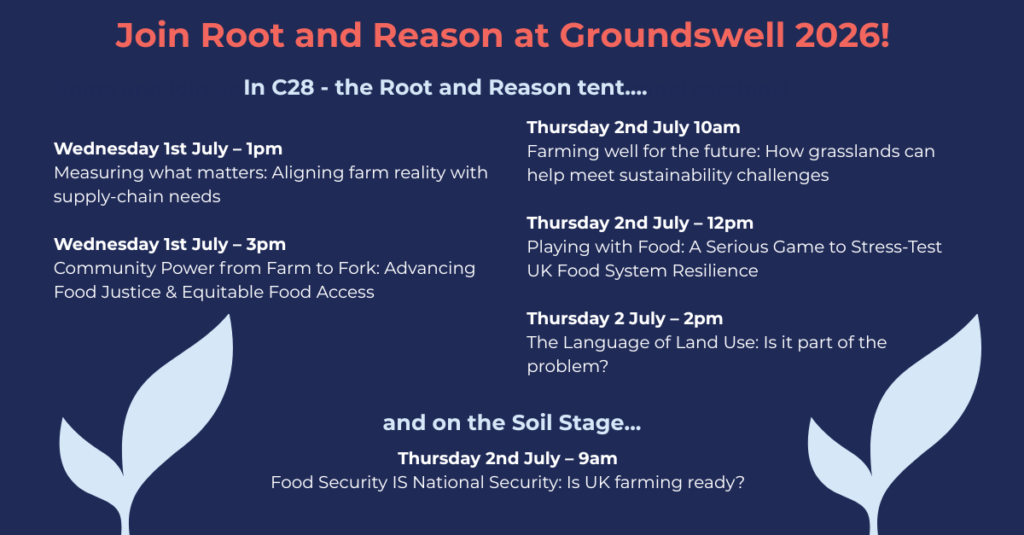
Come and find our tent at C28!
The Groundswell Festival provides a forum for farmers, growers, or anyone interested in food production and the environment to learn about the theory and practical applications of regenerative farming systems. Root and Reason will be hosting a stand, with a variety of sessions throughout the two days – we hope you can join us!
Our session on the Soil stage
Thursday 2nd July – 9am
Food Security IS National Security: Is UK farming ready?
Root and Reason’s work shows change is coming whether we plan for it or not: the question is whether the food and farming sector shapes or is shaped by it. In January, Defra warned that global ecosystem collapse could trigger food supply shocks within the decade. Yet while politicians talk about energy security with urgency and clarity, food security remains an afterthought.
Led by Emily Norton (Norfolk farmer and founder, Farm Foresight Ltd) with Daniel Zeichner (MP for Cambridge and former Defra Minister of State for Food Security & Rural Affairs) this session asks what would it take for food policy to give UK farmers the certainty they need.
Speakers: Daniel Zeichner, Jimmy Woodrow, Ali Morpeth
Our Sessions at the Root and Reason Stand – C28
Wednesday 1st July – 1pm
Measuring what matters: Aligning farm reality with supply-chain needs
This panel explores how data has become an important interface between farmers and food businesses in regenerative agriculture, and why poor alignment creates burden rather than value.
Drawing on real-world experiences from both farming and food business, the discussion, chaired by Tom McMillan, will unpack the growing number of carbon calculators, natural capital tools and buyer requests facing farmers, and the risks this creates for farm businesses and Tier 1 suppliers evidencing progress.
Speakers: Stephen Briggs, Star Molteno, Ben Williams
Wednesday 1st July – 3pm
Community Power from Farm to Fork: Advancing Food Justice & Equitable Food Access
Led by Fergus Lyon (Professor of Enterprise and Organisations at Middlesex University), this session explores how communities and growers can build alliances to transform local food systems, ensuring dignified, equitable access to nutritious, culturally relevant food. It highlights regenerative approaches that strengthen grower livelihoods, improve demand
predictability, and increase citizen choice.
Speakers: Hannah Gibbs, Katherine Langton, Martin Chadwick
Thursday 2nd July 10am
Farming well for the future: How grasslands can help meet sustainability challenges
Livestock farming in the UK comes in many shapes and sizes—and many are already cutting emissions, building soil carbon, and supporting wildlife, while
continuing to perform financially.
This session, led by Lisa Norton (Senior Scientist UK Centre for Ecology & Hydrology), will share findings from the Lunz Grassland for Net Zero project, working with livestock farming clusters across all four UK nations,
Speakers: Holly Shearman, David Patterson, Mark Lee
Thursday 2nd July – 12pm
Playing with Food: A Serious Game to Stress-Test UK Food System Resilience
Empty shelves, panic buying, and supply chain failures: we’ve seen how quickly food systems come under strain. But what happens when multiple shocks hit at once? How do farmers, suppliers, retailers and policymakers respond?
In this interactive workshop, led by Matteo Menapace (Beesnees Games Ltd), we’ll play
Barefood, a serious game developed by the BBSRC-funded BAFR-UK project. Rather than
talking about food system vulnerabilities, participants experience them first-hand.
Speakers: Elta Smith, Angelina Sanderson Bellamy, Holly Chalmers
Thursday 2 July – 2pm
The Language of Land Use: Is it part of the problem?
The successful transition of our farming system depends on the expertise and close collaboration of a variety of stakeholders – farmers, researchers, policy makers, corporates and NGO’s. However, these groups all use different language to frame and describe their work, and the objectives they are trying to achieve. Through the LUNZ Hub we have been exploring these terms and gathering feedback about those which are especially problematic, and why.
Chair: Harriet Fraser
Speaker: Jack Hannam
Our Speakers
Food Security IS National Security: Is UK farming ready?
| Ali Morpeth Co-Founder, Planeatry Aliance Ali is an award winning Registered Public Health Nutritionist (RNutr) working at the nexus of health and sustainability. She has delivered systemic changes that are win-win for people and planet. Ali has a track record of consulting for global businesses and retailers as well as working extensively with NGOs and on government food policy. |
| Emily Norton Norfolk farmer and founder, Farm Foresight Ltd Emily has 25 years’ experience in food and farming. Qualified as a lawyer, she also has an MSc in Sustainable Agriculture. Her career has taken her from family business to global PLC, with time spent in Brussels and across the UK. Emily is Chair of the AHDB, NED at Soil Association Exchange and trustee at the Royal Norfolk Agricultural Association. |
| Daniel Zeichner MP for Cambridge and former Defra Minister of State for Food Security & Rural Affairs Daniel focuses on UK food and farming policy – championing food security, resilient rural economies and nature-friendly farming. He works on policy linking farming, food security and the environment, with a long-standing focus on climate action and sustainable transport. |
| Jimmy Woodrow Chief Executive, Pasture for Life Jimmy is a leading voice in the Pasture for Life movement, supporting UK farmers to deliver profitable, low-input livestock systems based on diverse, well-managed grasslands. He works with producers and partners to share practical learning on grazing, soil health and outcomes-led assurance. |
Measuring what matters: Aligning farm reality with supply-chain needs
| Ben Williams Sustainability Manager at Leprino foods Ben’s passion is sustainability and circularity in UK agriculture. He manages complex solutions to the complex problems, supporting EMEA supply chains in GHG LCA reporting. Ben develops and delivers sustainability strategies that use behavioural insights to support systems change reducing scope 3 emissions. |
| Stephen Briggs Farmer and Head of Technical Development at Innovation for Agriculture Stephen has 25 years’ experience of farming systems, soil and water research in the UK and internationally. Alongside his role at IfA, he is Director of AbacusAgri and Non-Exec Director of AHDB. Stephen is a Nuffield Farming Scholar and at home, grows crops with the UK’s largest agroforestry system. He has previously worked for DFID, FAO and the World bank. |
| Star Molteno Sustainable Land Use, Farming & Forestry Specialist at Eunomia Research & Consulting Star provides technical expertise to UK policymakers and is co-leading the LUNZ Hub Futures Platform to develop emissions-mitigation pathways for agriculture and land-use sectors. Star also works with land managers, using data to set strategic goals balancing climate, biodiversity and land-use objectives. |
| Tom McMillan CEO at Ag-Impact CEO at Ag-Impact, a non-profit that helps agricultural scientists and research funders to make their work count on the ground. Previously the Elizabeth Creak Chair in Rural Policy & Strategy at the Royal Agricultural University, and now a Visiting Professor. Advisor to the Food, Farming & Countryside Commission (FFCC), and was part of the team who produced the National Food Strategy. Ex-Director of Innovation at the Soil Association. |
Community Power from Farm to Fork: Advancing Food Justice & Equitable Food Access
| Fergus Lyon Middlesex University, Professor of Enterprise and Organisations Fergus is a university professor and has been working on alternative food enterprise approaches for over 30 years. He led the research project, Social enterprise as a catalyst for sustainable and healthy local food systems and led research on Natural Capital: what farmers and policy makers need to know, for the Food Farming and Countryside Commission. Recent research is on capabilities farmers and intermediaries need for developing regenerative business that are positive for nature. Fergus is also the managing director of Easthall Farm that was the first farm to become a B Corp in the UK |
| Hannah Gibbs Sustain – The Alliance for Better Food and Farming; Bridging the Gap programme Manager Hannah joined Sustain in November 2022 as Programme Manager for the Bridging the Gap programme, demonstrating ways to build better supply chains between climate and nature friendly food and people on a lower income. Hannah has a background in leading international development programmes, community building and campaigning. |
| Katherine Langton Langton’s Farm Katherine has a degree in Environment and Sustainability, she has been growing vegetables on her mother’s allotment and veggie patch since she was a child. Langton’s Farm have been involved in the Welsh Veg in Schools pilot delivering organic veg into Welsh Schools since 2024. |
| Martin Chadwick FoodSEqual Project, University of Reading Martin leads work on culturally appropriate vegetable growing, community participation and connectivity with agricultural systems. Leads the evaluation of innovative food access pilots in communities. His research focuses on equity, social connectivity and evidence‐based approaches to improving access to fresh, nutritious food in diverse communities. |
Farming well for the future: How grasslands can help meet sustainability challenges
| David Patterson AFBI Grassland Agronomist NI David earned his PhD in grass/white clover species dynamics from Queen’s University in 1991. After roles in turfgrass breeding research at Queen’s University Belfast and as a Grassland Technologist at CAFRE, he worked in education, compliance, and agricultural policy within DAERA. In 2018, he returned to grassland systems research at AFBI Hillsborough. His current research focuses on silage systems, grassland resilience, and multi-species swards, aiming to balance production efficiency with ecosystem sustainability. |
| Holly Shearman Innovation for Agriculture & Royal Agricultural Society of England – Head of Livestock and Farm of the Future Programmes Holly believes that healthy livestock and healthy pastures are inextricably linked. She is passionate about the role of regenerative grassland management in building resilient, circular farm economies. Holly manages a flock of sheep on her family farm, where she implements sustainable grazing strategies firsthand. |
| Lisa Norton Senior Scientist UK Centre for Ecology and Hydrology Lisa is a senior scientist and has worked on farming practices and biodiversity, with farmers, policy makers and farming bodies for more than 25 years. She has led many Defra funded projects that aim to understand more about farming systems and how to manage land in ways which support both farming and biodiversity in the long-term. |
| Mark Lee Farmer LUNZ Grasslands cluster Mark and his wife Jenny manage their Torpenhow Farm in North Cumbria in partnership with Jenny’s parents. Initially they ran their dairy quite intensively, milking Holstein cows three times a day, but in 2017 the farm stopped all use of fertiliser, pesticide and herbicide and are now fully organic. They now farm – a cross-breed of Jersey, Friesians and Norwegian Red – graze almost all year round, save a few weeks in December and January, with the herd rotating between different paddocks which are divided up by native hedgerows. They have several small businesses on their farm premises, including a wedding venue and cheese and gelato production. They were one of a cluster of Cumbrian dairy farmers involved in the LUNZ project. |
Playing with Food: A Serious Game to Stress-Test UK Food System Resilience
| Angelina Sanderson Bellamy Root and Reason (formerly AFN Network+); Director Angelina co-founded the AFN Network+, which has over 3,500 members from across the food system. Central to Angelina’s work is convening members to contribute to more democratic processes that result in thought leadership and more equitable and just food system outcomes. |
| Holly Chalmers Research Associate – Resilient Food Systems As a Research Associate at UWE Bristol, Holly works across food policy, land use and systems thinking, bringing people together to explore resilience in a changing world. She is interested in how we imagine and build better food futures and her practice combines research with creative and participatory methods, to test ideas and navigate uncertainty. Holly is currently working on the UKRI and Defra funded BAFR project, and the Defra and Welsh Government funded Wye Catchment Living Labs. |
| Elta Smith Root and Reason (formerly AFN Network+); Director Elta co-developed the Barefood game and has facilitated sessions with diverse groups across the food system. She is a co-founder and director at Root and Reason, and a visiting researcher at the Global Sustainability Institute, Anglia Ruskin University. |
| Matteo Menapace Beesness Games Ltd, Director Matteo Menapace is best known as the co-designer of the critically acclaimed Daybreak, a cooperative board game about stopping climate breakdown. Matteo designs and delivers bespoke “serious” games, ranging from playful policy simulations for strategic planning, to gamified consultation processes for stakeholders engagement. |
The Language of Land Use: Is it part of the problem?
Harriet Fraser
Place Collective, co-founder
Harriet is a poet, artist and geographer, whose practice and PhD research explore agency and action in landscape change. She works closely with farmers and is a trustee for the Foundation for Common Land. Within the LUNZ Hub consortium she co-leads the PLACE Collective group of artists engaging in issues of land and land management
Jack Hannam
Professor in Sustainable Agriculture and Biodiversity, Head of Agriculture, Health and Environment Department, University of Greenwich
Jack is a soil scientist with a particular interest in different forms of soil data, soil knowledge and analysis frameworks and how they inform local soil management and nationals scale monitoring schemes, She works in transdiscipliary teams developing new ideas around soil and land systems and translates these into evidence for decision making
Our partners at Groundswell
★LUNZ Hub, LUNZ Grasslands, LUNZ Openland and LUNZ JustLanz
★Transforming UK Food Systems (TUKFS)
★Eunomia
★Backcasting to Achieve Food Resilience in the UK (BAFR-UK)